LANDSCAPE PROFILE
Surrey Hills
England’s most wooded National Landscape, half an hour from London, entering a period of profound structural change.
Surrey, South East England, UK
An independent Pandion reading. We observe and synthesise this landscape through our sustainability framework, taking a whole-landscape view across the Surrey Hills National Landscape and its constituent bodies. Pandion is a member of Surrey Hills Enterprises CIC (one constituent within the wider NL umbrella) and is active locally; this page is not produced by, nor representative of, the Surrey Hills National Landscape body — it complements rather than mirrors any single constituent body's view.
PROFILE
England’s most-wooded National Landscape, half an hour from London, entering its most consequential structural window since 1958: a boundary extension, a council reorganisation, and a new Management Plan, all converging through 2026 and 2027.
The Surrey Hills is one of England’s original AONBs (designated 1958), now a National Landscape. At 422 km² it covers roughly a quarter of Surrey, England’s most densely wooded county. The landscape sits half an hour from London and Gatwick: visitor-heavy, commuter-belt, but agriculturally and ecologically active. Major landowners include the National Trust (4,000+ ha), Hampton Estate (BNG pioneer) and Denbies Wine Estate (B Corp leader).
Three structural changes are converging in 2026 and 2027: a 25–30% boundary extension under Natural England review, local government reorganisation creating East Surrey and West Surrey unitary authorities by April 2027, and the implementation of the new Management Plan 2025–2030 with its 75-year vision. The actor ecosystem is rich but fragmented; no single body is connecting actors around shared sustainability goals at landscape scale.
GOVERNANCE & JURISDICTION
Where this sits in the UK governance hierarchy.
Surrey Hills sits within the UK local-government hierarchy and, additionally, within the National Landscapes designation regime. The framework reads at the statutory designation level (Surrey Hills National Landscape), which spans five Local Planning Authorities. Unlike Krupanj-Planina, where no formal landscape-scale tier exists, the UK has a dedicated statutory landscape designation: Surrey Hills is governed at landscape scale by the Surrey Hills Board, with planning powers retained by the constituent LPAs.
LANDSCAPE STEWARDSHIP
Who holds the land, and what they do with it.
Beneath the governance hierarchy sits the operational layer: the entities that hold legal title to the land and would be the counterparties for any nature-market instrument — Biodiversity Net Gain, Woodland Carbon Code, the Farming in Protected Landscapes (FiPL) fund (administered by the Surrey Hills NL Team), Countryside Stewardship, and emerging biodiversity and water credits. Pandion's reading is across the whole National Landscape, drawing from multiple sources within the NL umbrella: Surrey Hills Enterprises CIC member listings (for the business-facing stewards), the Surrey Hills NL land-managers programmes (for FiPL participants and farming partnerships), National Trust Open Data (for the dominant conservation steward), and Pandion-curated additions where the public record allows. The categorisation below is by business archetype. This is an MVP: anchor stewards, not an exhaustive map of the ~250+ land-holding entities within the National Landscape boundary.
THROUGH THE FRAMEWORK
The framework, applied to this place.
Our sustainability framework reads each landscape across layers, flows, cross-cutting enablers, and actors. Below: the headline insight from each, applied to Surrey Hills.
L1
layer
Planetary Foundations
England’s most wooded National Landscape (47% canopy, against a county average of 22.4%), yet zero verified Woodland Carbon Code projects. The climate contribution is real; market visibility is not.
L2
layer
Landscapes & Jurisdictions
422 km² across five planning authorities. Three structural changes converging through 2026 and 2027: boundary extension under Natural England review, local government reorganisation to East/West Surrey unitaries (April 2027), and the new Management Plan 2025–2030.
L3
layer
Ecosystem Services
Ecosystem services span all four classes: provisioning (wine is the standout emerging product, with England's largest vineyard here), regulating (carbon sequestration in the 47% woodland canopy, water purification through the chalk aquifer), supporting (chalk-grassland biodiversity, soil formation), and cultural (the medieval Pilgrims' Way / North Downs Way corridor, 5,000+ Listed Buildings, Scheduled Monuments at St Martha's Hill / St Catherine's Chapel / Guildford Castle / Waverley Abbey, Registered Parks & Gardens including Munstead Wood and Polesden Lacey). Revenue stacking across services is viable but largely untapped; the cultural services in particular are economically expressed via the visitor economy and property premia rather than directly monetised.
L4
layer
Policy & Governance
Strong statutory framework (LURA 2023, AONB protection). UK SRS and mandatory BNG (since Feb 2024) are creating new corporate obligations the landscape is positioned to absorb, if delivery infrastructure exists.
L5
layer
Corporate Action
Denbies Wine Estate sets the corporate sustainability ceiling: B Corp 2024, UK’s first Net Zero wine producer, King’s Award 2025. Golf courses (seven-plus) are the most visible gap: none with GEO certification or formal environmental reporting.
Capital Flows
flow
Capital
Public capital has been the backbone (FiPL £2.29M since 2021, programme ended March 2026). Private nature markets are nascent: carbon entirely untapped, BNG supply limited to two habitat banks against five LPAs’ mandatory demand.
Data Flows
flow
Data
World-class scientific capacity (Space4Nature at COP30; NatureMetrics, Earthshot Prize finalist) sits alongside data fragmentation across six authorities. No integrated landscape data platform exists.
Cross-Cutting
cross cutting
Enabling Systems
Strong scientific capacity but weak practitioner translation. The FiPL public advisory programme ended in March 2026, leaving an advisory gap that no obvious successor is filling.
Cross-Cutting
cross cutting
Social Sustainability
Acute housing unaffordability. The people who manage the landscape (farmers, conservation workers, hospitality staff) are increasingly priced out of living in it. The workforce paradox is structural, not cyclical.
Cross-Cutting
cross cutting
AI in Sustainability
The technical building blocks exist (sensor networks, satellite analysis, eDNA monitoring). What is missing is the orchestration that connects them to landscape-scale decisions.
Actors
actors
Actor Ecosystem
Rich and varied: strong governance (Surrey Hills Board, Surrey Hills Enterprises CIC), active conservation (National Trust, Surrey Wildlife Trust), pioneering businesses, deep academic capacity, and adjacent disclosure-obligated corporates with operations in or near the NL. Fragmented: no one connecting these actors around shared sustainability goals at landscape scale.
STRATEGIC OPPORTUNITIES
Where capital, capacity and place could meet.
| Opportunity | Potential |
|---|---|
| Post-FiPL private advisory market | Public advisory ended March 2026: a private-sector advisory gap visible at landscape scale. |
| Golf course environmental stewardship | Seven-plus courses across the NL manage significant ecological land. Scope to convene the sector on landscape-scale coordination, certification pathways (GEO and similar) and aggregated environmental reporting, building on work some clubs already do via Surrey Hills Enterprises. |
| BNG habitat bank expansion | Mandatory demand from all five LPAs against a thin local supply: one registered bank (Chiddingfold) plus one in development (West Horsley). Statutory credit price set deliberately high to incentivise local supply. |
| Woodland Carbon Code pathway for estates | England’s most wooded National Landscape with zero verified projects. The raw material is there; registration, verification and aggregation are not. |
| Corporate nature programmes (UK SRS / TNFD) | Multiple disclosure-obligated corporates with operations in or near the NL are proximate; landscape-level nature data is exactly what they need. |
| Wine cluster sustainability narrative | England’s largest vineyard sits here, and the Vineyards of the Surrey Hills group already coordinates the cluster’s identity and wine-tourism story. The sustainability dimension (water stewardship, soil carbon, biodiversity practice) is a natural complement still to develop at landscape scale. |
| Integrated landscape data platform | Transformative if built: a single analytical view connecting Space4Nature, NatureMetrics, planning data, statutory designations and citizen science. No single constituent body holds this brief today. Pandion would be open to exploring a facilitating or coordinating role here, through Surrey Hills Enterprises membership and alongside the existing family of five organisations. This landscape view is an early seed of what such a hub could look like. |
CAPITAL CONTINUUM
Stage 2: Implementation (with nature-market capital newly layering in)
Capital appropriate at this stage: A mature blended public-private base is in place: Defra core grant plus 75% local-authority match, National Trust contribution to the Joint Advisory Committee, Surrey Hills Enterprises CIC (~240 members alongside a stable of corporate partners and sponsors), the charitable Surrey Hills Trust Fund, and project-specific grants (Access for All, Heritage Building Restoration, Heathland Connections, FiPL through to 2025/26). The newer overlay — private nature-market capital (BNG, WCC, UK SRS-driven corporate nature spend) — is structurally mandated and starting to flow. The binding constraint for nature-market scaling is landscape-level aggregation infrastructure, not capital availability or counterparty maturity.
Surrey Hills has been a statutory landscape since 1958 (AONB then renamed National Landscape in 2023), with an established family of five organisations (Board, National Landscape team, Enterprises CIC, Society, Arts) and a working public-private funding mix. Counterparty, policy-legal and the conventional funding pillar sit at Stage 2-3 maturity. The specifically nature-market dimension is earlier (Stage 1-2): BNG mandatory demand from five LPAs, UK SRS coming through, WCC entirely untapped. The interesting question for the next phase is how the nature-market layer integrates with the existing mature governance, not whether the landscape itself is operational. Movement deeper into Stage 2 is likely to be driven by aggregator infrastructure: a connective-tissue role that does not currently sit with any single constituent body. As Surrey Hills Enterprises members, Pandion would welcome exploring how we could help facilitate or coordinate part of that role, alongside the existing family of five organisations rather than as a competing structure.
POSITION ON THE LIFECYCLE
FIVE PILLARS OF INVESTMENT READINESS
Each pillar must be in place before this landscape can absorb scaling capital. Status reflects current observation, not aspiration.
Counterparty
IN PLACEThe strength and credibility of the project proponent, local implementing partners, and alignment of incentives across stakeholders.
A mature counterparty stack: statutory Surrey Hills Board (Joint Advisory Committee, Defra + National Trust + Surrey CC + five LPAs), Surrey Hills Enterprises CIC (~240 members plus corporate partners and sponsors), the charitable Surrey Hills Trust Fund, and credible landowner partners (National Trust at 4,000+ ha, Hampton Estate). The gap is not counterparty strength but the absence of a single body convening these as a market-facing landscape-scale aggregator for nature-market capital.
Anchored to framework: Actors
Policy & Legal
IN PLACENational and sub-national policy environment, regulatory clarity on carbon and land rights, security of approvals and agreements.
UK property and carbon law are mature. LURA 2023 strengthened AONB protection. Mandatory BNG (Feb 2024). UK SRS framework now active. National Landscape designation provides statutory protection and a Management Plan vehicle. The legal scaffolding is the most developed pillar.
Anchored to framework: L4
ESG & SDG
PARTIALCommunity engagement legitimacy, safeguards, benefit-sharing arrangements, contribution to wider development goals.
Mature corporate ESG actors are proximate to the NL footprint. Management Plan 2025–2030 articulates a 75-year vision. The gap is landscape-level benefit-sharing infrastructure: no mechanism to channel corporate nature spend into landscape-scale outcomes with clear safeguards and community engagement.
Anchored to framework: Social Sustainability
Technical / Implementation
PARTIALMethodological credibility, baseline data quality, capacity to deliver at scale.
World-class science capacity: Space4Nature (University of Surrey + Surrey Wildlife Trust, COP30 showcase), NatureMetrics (Earthshot Prize finalist), the Landscape Observatory, Surrey Biodiversity Information Centre. MRV pathways exist nationally. The gap: data fragmented across six authorities; no integrated landscape data platform; weak practitioner translation.
Anchored to framework: Data Flows
Commercial & Finance
PARTIALFinancial model resilience, funding strategy, long-term viability of revenue streams.
The conventional funding pillar is mature: Defra core grant plus 75% local-authority match, National Trust contribution, Surrey Hills Enterprises CIC corporate partners and members, the charitable Trust Fund, and project-specific grants. FiPL (£2.29M since 2021) is ending after a Defra extension to 2025/26, creating a near-term funding adjustment rather than a cliff. The newer nature-market commercial pillar is earlier: BNG demand mandatory from five LPAs against one registered bank plus one in development; UK SRS coming through; WCC entirely untapped despite this being England's most wooded National Landscape. No landscape-level nature-market vehicle or aggregator exists yet.
Anchored to framework: Capital Flows
CRITICAL GATING ITEMS
The prerequisites that stand between this landscape and Stage 2 implementation capital. Each one gates a different pillar.
- 1Landscape-scale nature market aggregatorCOMMERCIAL & FINANCE
Mandatory BNG demand from five LPAs and emerging UK SRS-driven corporate nature spend both need an aggregator that can package landscape-scale supply against fragmented demand. Without it, capital deploys piecemeal at sub-optimal scale.
- 2First Woodland Carbon Code projectsCOMMERCIAL & FINANCE
Zero WCC projects in England’s most wooded National Landscape is the headline market failure. The first registered project breaks the precedent; aggregation can follow.
- 3Post-FiPL private advisory bodyCOUNTERPARTY
FiPL public advisory ended March 2026. Without a private-sector successor, the practitioner translation gap (Theme 5) compounds and the science-to-action pathway atrophies.
- 4Integrated landscape data platformTECHNICAL / IMPLEMENTATION
Six authorities, multiple science partners, multiple data formats. Aggregation is the single change that would unlock BNG planning, corporate nature disclosure and landscape-scale MRV simultaneously.
- 5Stable governance through the 2026–2027 transitionPOLICY & LEGAL
Boundary extension under Natural England review, plus local government reorganisation to East/West Surrey unitaries in April 2027. The Management Plan and Surrey Hills Board need to carry strategic continuity through the transition.
Framework source: Capital Continuum Advisers, Deploying Climate Finance Along the Capital Continuum (Berardo et al., March 2025) and the 5-Pillar Investment Readiness methodology (Kiss, Sept 2025).
CURRENT STATE
Three structural changes converging through 2026 and 2027: a 25–30% boundary extension under Natural England review, local government reorganisation creating East and West Surrey unitary authorities by April 2027, and the implementation of the new Management Plan 2025–2030. The most consequential governance window since 1958.
FROM THE LANDSCAPE
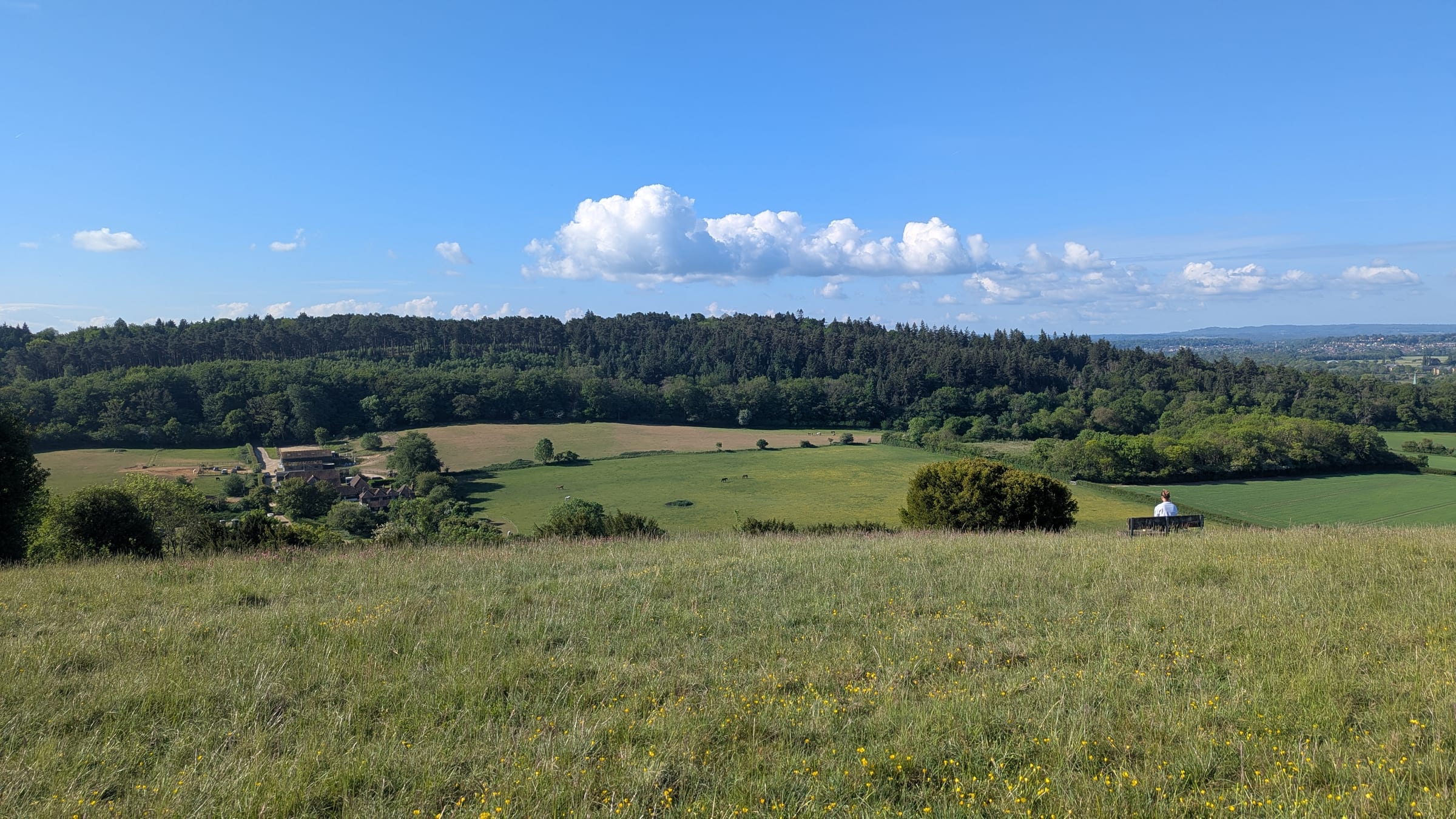
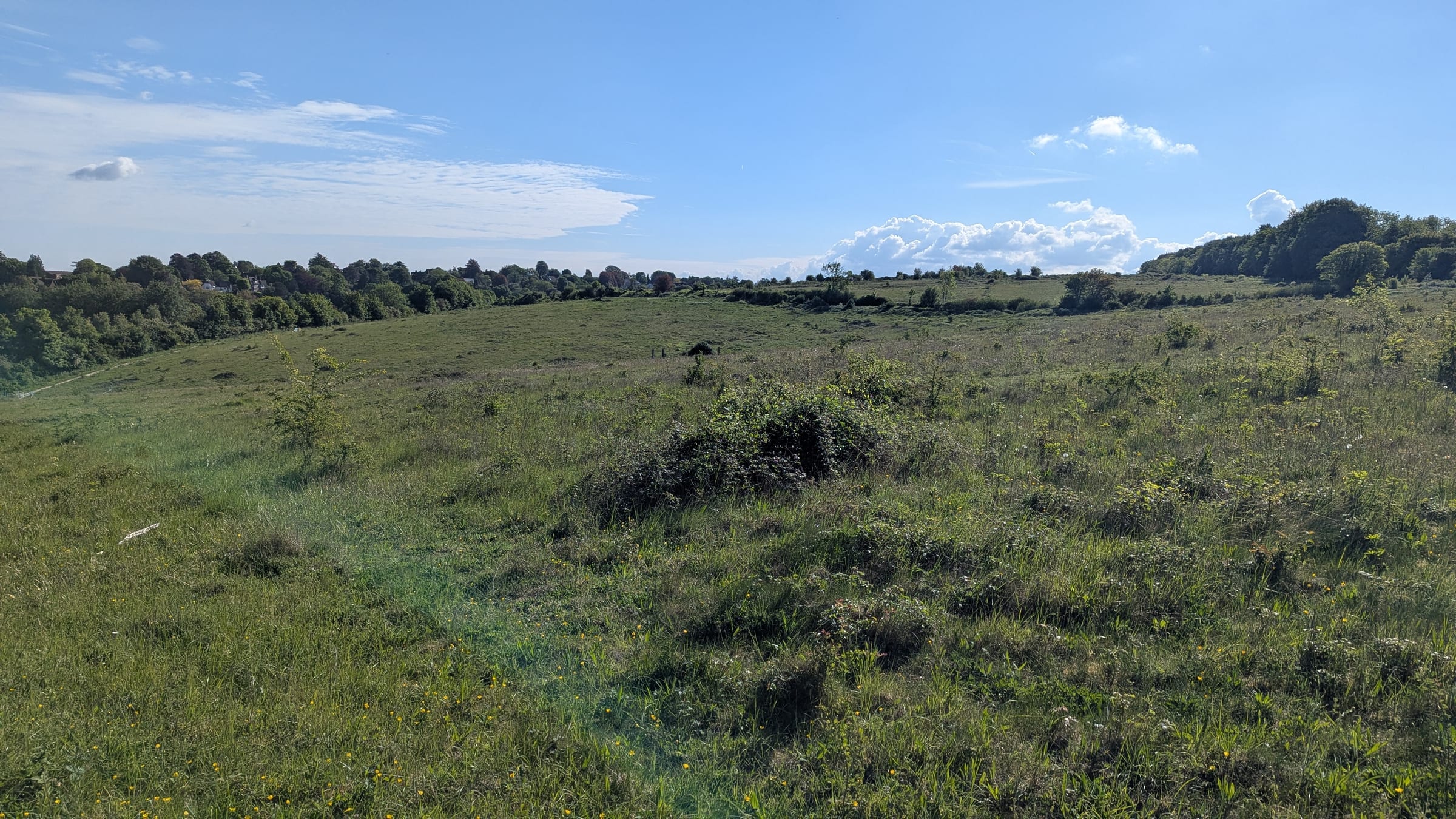
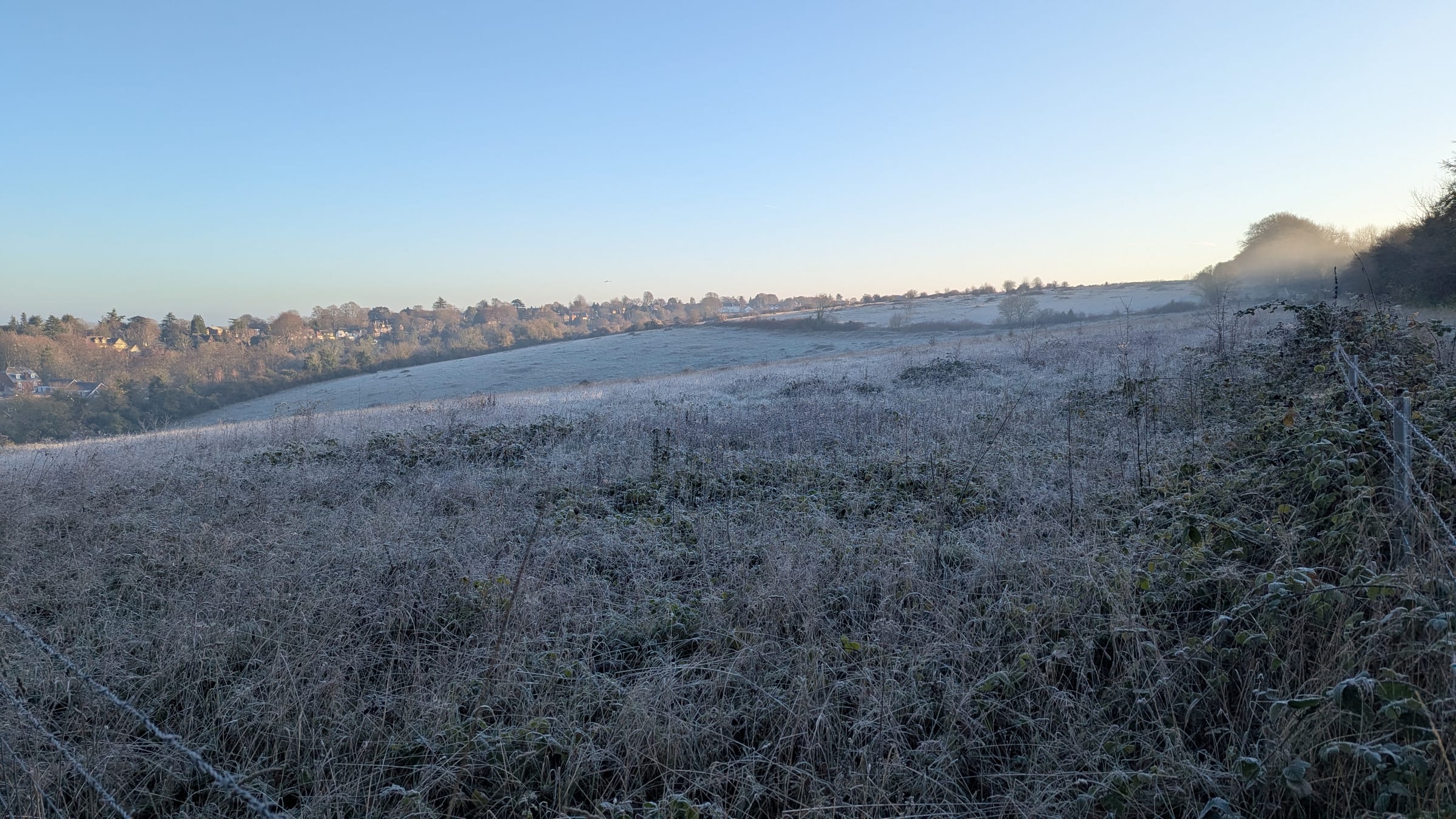
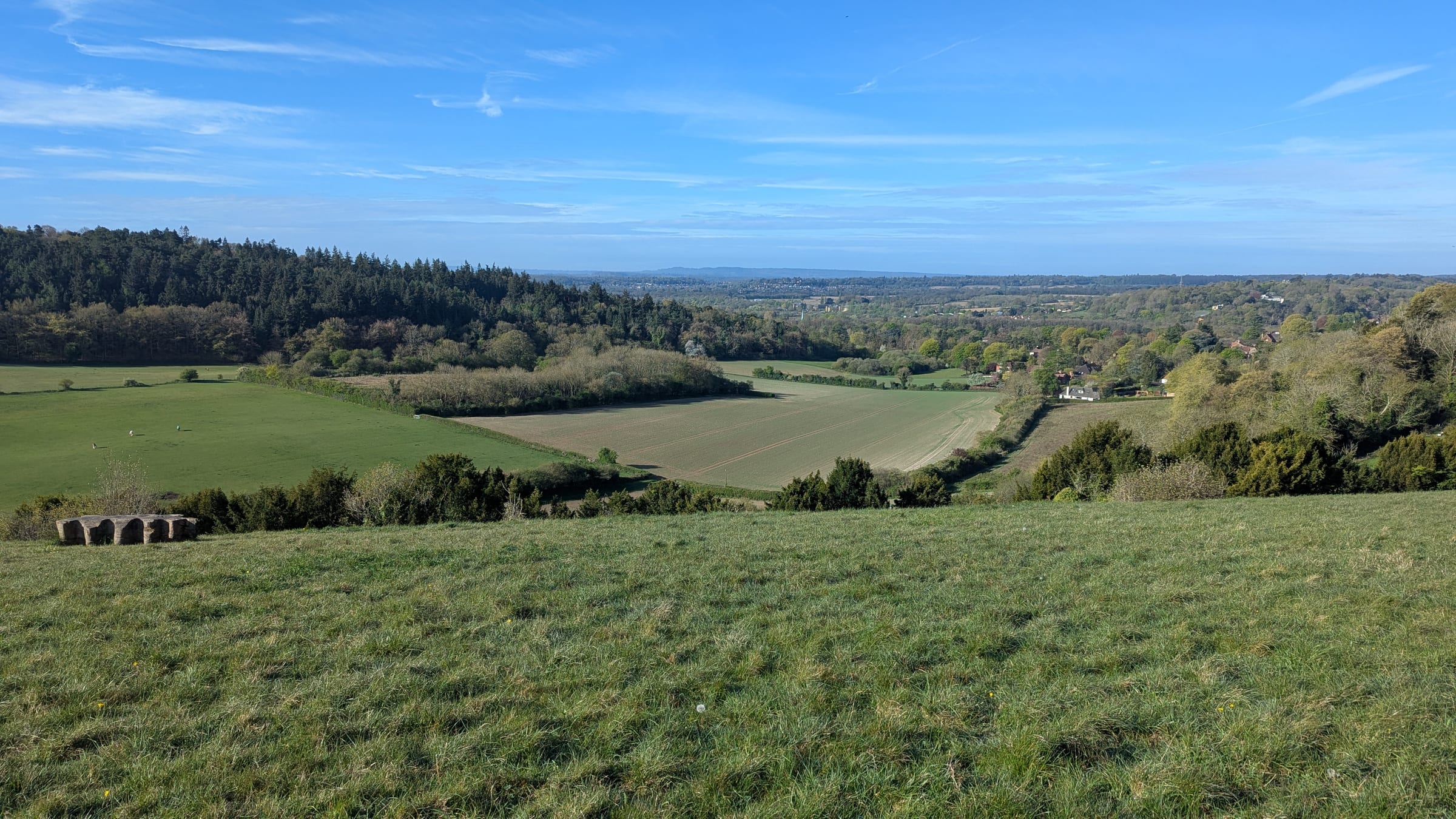
Pewley Downs, season to season