
LANDSCAPE PROFILE
Providenciales
A low-lying limestone island on the western edge of the Turks & Caicos archipelago. Grace Bay reef and beach, Princess Alexandra National Park, the tourism economy that defines the territory, and the front line of TCI's climate exposure.
Providenciales · Turks & Caicos Islands · British Overseas Territory · Caribbean
An independent Pandion reading of Providenciales as a SIDS landscape. We observe and synthesise through our sustainability framework. We are not a managing or governing body, and there is no established implementing partnership in this landscape. The wider TCI archipelago is held in view as the constitutional and SIDS frame; the other TCI islands (Grand Turk, Salt Cay, North/Middle/East Caicos) will get their own readings in future phases.
PROFILE
A low-lying limestone island on the western edge of the Turks & Caicos archipelago. The tourism and population hub of a British Overseas Territory, anchored on Grace Bay's reef-and-beach system, with acute climate exposure as the existential frame.
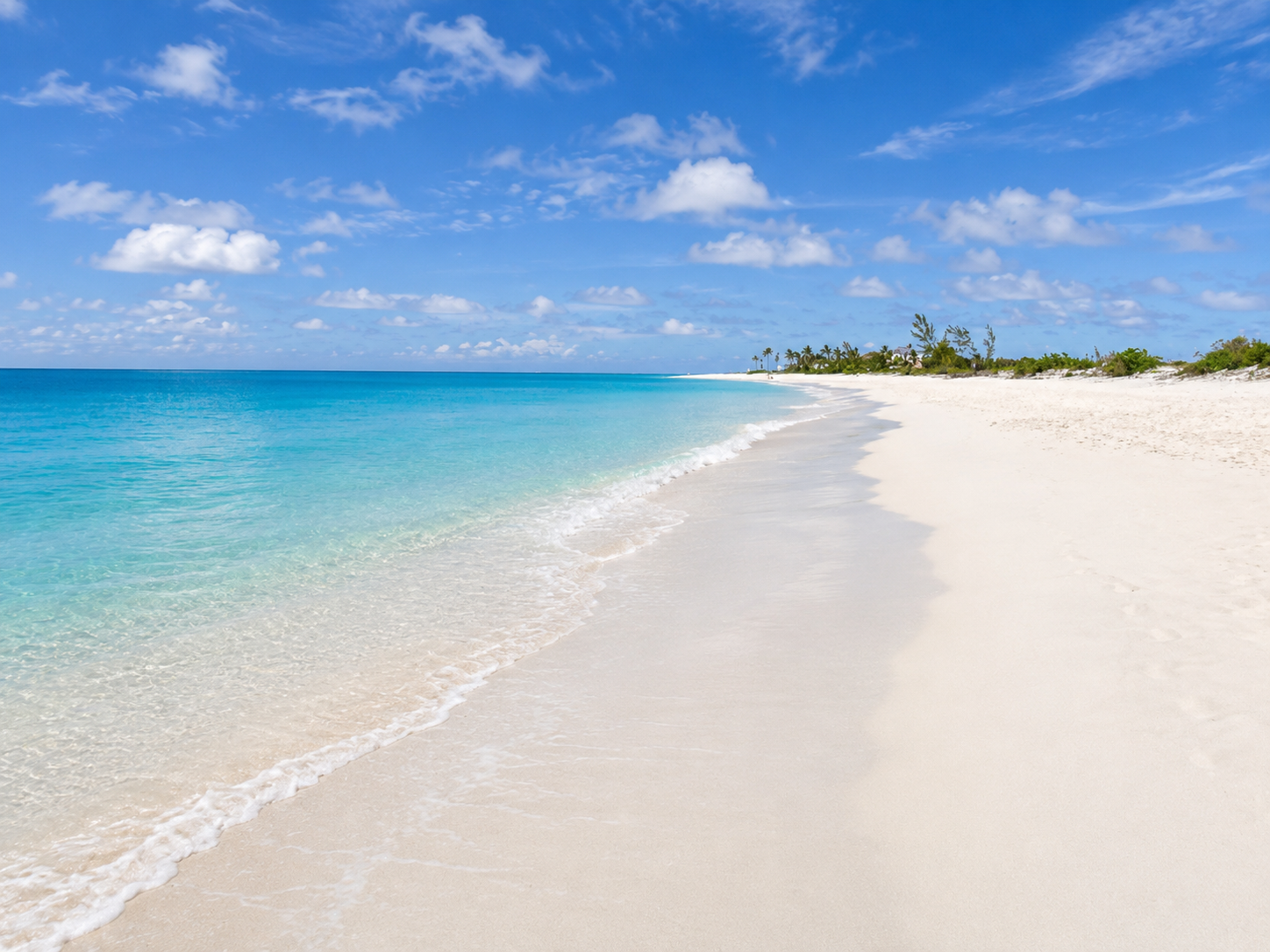
Providenciales (~98 km²) is the tourism and population hub of the Turks & Caicos Islands, a British Overseas Territory in the northern Caribbean. The island concentrates around 24,000 residents (~40% of the territory's population) and hosts the great majority of TCI's ~1.6 million annual visitors. Grace Bay on the north shore — a continuous reef-and-beach system inside Princess Alexandra Land & Sea National Park — is the economic and ecological anchor. Chalk Sound National Park on the south-west, Northwest Point Marine National Park, and the island's coastal wetlands round out the protected-area mosaic on Providenciales. The economy is tourism-monoculture: a small number of hotel and resort operators along Grace Bay effectively define the L5 / corporate landscape.
The framework reading focuses here, on Providenciales, at the scale where Pandion would actually engage. The wider Turks & Caicos archipelago (38 islands, 8 inhabited, ~948 km² total, ~58,000 population, ~26% of territory under formal protection) is held in view through governance layers — the constitutional cover (BOT), the SIDS frame, the territorial environmental authority (DECR), the Capital Continuum reading at TCI policy level. Other inhabited islands (Grand Turk and Cockburn Town as the capital, the historic salt industry on Salt Cay, the Ramsar wetlands on North, Middle and East Caicos) carry their own distinct landscape readings that future Pandion phases would surface separately.
Hurricane exposure is high; Irma (2017) is the defining recent event for the territory. Sea-level rise is structural — Providenciales' highest point is under 50 metres. The Grace Bay reef's condition is the leading indicator for both the tourism economy and the marine natural-capital story.
Toggleable layers (Providenciales focus + the wider-TCI governance context + reefs, wetlands, beaches, bays, hotels & resorts, marinas, settlements, transport) are sourced from OpenStreetMap (ODbL) via the Overpass API. The legal protected-area network (Princess Alexandra LSNP, Chalk Sound NP, Northwest Point Marine NP), the Ramsar wetlands (N/M/E Caicos — not a Providenciales feature), and Allen Coral Atlas benthic detail all need external sources — flagged in the wishlist below.
GOVERNANCE & JURISDICTION
Where this sits in the BOT and TCI governance hierarchy.
Providenciales is one of six TCI administrative districts. TCI itself sits within the British Overseas Territory framework, self-governing on most domestic matters under UK constitutional cover. Capital and policy instruments operate at TCI level (TCIG / DECR is the focal jurisdictional counterparty); landscape-scale implementation work would naturally anchor on Providenciales — the tourism, population and institutional centre.
THROUGH THE FRAMEWORK
The framework, applied to this place.
Our sustainability framework reads each landscape across layers, flows, cross-cutting enablers, and actors. Below: the headline insight from each, applied to TCI. First-pass; deepens iteratively.
L1
layer
Planetary Foundations
Acute climate vulnerability on a low-lying limestone archipelago. Hurricane Irma (2017) is the defining recent event; sea-level rise is the structural one. Coral bleaching events are increasing in frequency.
L2
layer
Landscapes & Jurisdictions
Providenciales is one of six TCI administrative districts. TCI itself is a self-governing British Overseas Territory under UK constitutional cover; ~26% of the territory is under formal protection. On Providenciales specifically: Princess Alexandra Land & Sea National Park (north shore), Chalk Sound National Park (south-west) and Northwest Point Marine National Park (west) are the main statutory designations.
L3
layer
Ecosystem Services
Significant marine natural capital (coral reefs, mangroves, seagrass) heavily monetised through tourism but largely unmonetised through nature markets. Blue carbon, reef-positive concierge, and PES models are all latent rather than active.
L4
layer
Policy & Governance
BOT status opens UK-channelled finance (Darwin Plus, Blue Belt). SIDS status opens multilateral climate and biodiversity windows. The "no high-rise" marketing line conceals a more specific reality: 2023 Development Manual amendments (§3.5.2 / §3.5.3) permit 8–12 storeys (up to 150 ft) in designated coastal corridors (Grace Bay, The Bight, Turtle Cove) subject to 100–200 ft vegetation-line setbacks and 5-acre minimum parcels. The story is zoned-density with setback discipline, not absence of density. Offshore financial services regulation is a separate and significant policy frame for the territory's second economy.
L5
layer
Corporate Action / Enterprise Development
Tourism is the corporate landscape. Hotel and resort decarbonisation, reef-positive concierge premium, and property-level nature-positive standards are the natural L5 surface. Concentration of the enterprise base means a small number of conversations would shift a large share of the economy.
Capital Flows
flow
Capital
Capital pathways exist (UK ODA, GCF, GEF, Caribbean Biodiversity Fund, hotel-group balance sheets). The constraint is locally-anchored projects with credible MRV that can absorb them. Blue carbon is the most realistic emergent revenue mechanism, gated on mangrove baselining.
Data Flows
flow
Data
Marine ecosystem data is partial: reef condition is monitored via DECR and external partnerships, but coverage is uneven. Mangrove and seagrass baselines need work. Satellite-derived products (Allen Coral Atlas, Global Mangrove Watch) are open-data starting points.
Cross-Cutting
cross cutting
Enabling Systems
Small-state dynamics: institutional capacity is concentrated in a few people across DECR, TCI National Trust and the Hotel & Tourism Association. Single-point-of-failure risk is real. The same concentration makes coordination tractable: there are not many tables to sit at.
Cross-Cutting
cross cutting
Social Sustainability
Tourism-dependent economy with significant seasonal and migrant labour. Post-Irma recovery is the recent test of social resilience. Belonger / non-Belonger status shapes labour markets and political voice; sustainability work has to read this carefully.
Cross-Cutting
cross cutting
AI in Sustainability
Most useful in the background: satellite reef monitoring, hurricane and SLR scenario modelling, grant-writing capacity for stretched institutions. Not yet present locally as a frontline tool.
Actors
actors
Actor Ecosystem
Small and concentrated: TCI Government (DECR principally), TCI National Trust, Hotel & Tourism Association, a handful of major hotel groups, climate-vulnerable communities on the outer islands. The actor map is short, which makes coordination realistic if relationships are in place.
STRATEGIC OPPORTUNITIES
Where capital, capacity and place could meet.
| Opportunity | Potential |
|---|---|
| Hotel / resort sustainability brief (Grace Bay) | Property-level sustainability brief, decarbonisation plan, reef-positive concierge proposition. The natural surface for L5 work given tourism dominance — concentrated on Grace Bay. |
| Reef-positive tourism premium (Grace Bay reef) | Pricing premium for properties demonstrably contributing to Grace Bay reef condition; useful for hotel-group differentiation. Allen Coral Atlas benthic data would unlock the MRV side. |
| Hurricane resilience + climate adaptation advisory | Property-level climate risk briefs on Providenciales; territory-level adaptation finance scoping; Caribbean SIDS positioning. |
| Chalk Sound coastal-lagoon stewardship | Distinctive 5 km² shallow turquoise lagoon with National Park designation. Stewardship work could anchor a Providenciales-specific nature-positive proposition. |
| DECR / TCI National Trust capacity bridge | Convening + analytical support for stretched institutions (operating at TCI level); rather than substituting for them. The realistic Pandion role. |
| Future phases: per-island readings | Other TCI islands carry distinct landscape readings: Grand Turk (capital + cruise economy + historic salt industry), N/M/E Caicos (Ramsar wetlands + mangrove blue carbon), Salt Cay (heritage + dormant industry). Each would get its own landscape page following the Providenciales template. |
CAPITAL CONTINUUM
Stage 1: Incubation (early)
Capital appropriate at this stage: Grants, philanthropy, technical assistance, capacity building. UK BOT-targeted funding (Darwin Plus, Blue Belt) is the most natural channel; SIDS-allocated multilateral finance is open in principle but requires credible local proponents.
TCI sits in early Stage 1 on the Capital Continuum. Counterparty infrastructure is more developed than greenfield landscapes (DECR, TCI National Trust, MPA network all exist), which puts TCI ahead of pre-Stage-1 territories. Nature-market infrastructure is largely absent: no blue carbon projects, no biodiversity credits, no PES schemes. The work of this stage is connecting the existing institutional spine to the emerging nature-finance instruments, with locally credible MRV as the gating constraint.
POSITION ON THE LIFECYCLE
FIVE PILLARS OF INVESTMENT READINESS
Each pillar must be in place before this landscape can absorb scaling capital. Status reflects current observation, not aspiration.
Counterparty
PARTIALThe strength and credibility of the project proponent, local implementing partners, and alignment of incentives across stakeholders.
Established institutions exist (DECR, TCI National Trust, Hotel & Tourism Association). Pandion has no formal sustainability proponent role; the counterparty for any specific instrument would need to be DECR-sponsored or NGO-led.
Anchored to framework: Actors
Policy & Legal
EMERGINGNational and sub-national policy environment, regulatory clarity on carbon and land rights, security of approvals and agreements.
BOT constitutional frame is clear. Protected-area legislation is well-established. Carbon-rights and blue-carbon legal frameworks are not yet defined for TCI specifically; would need scoping before any market-based mechanism could operate.
Anchored to framework: L4
ESG & SDG
EMERGINGCommunity engagement legitimacy, safeguards, benefit-sharing arrangements, contribution to wider development goals.
Implicit alignment with SDG 13, 14, 15 is strong given the marine and climate-adaptation context. Belonger / non-Belonger labour-market dynamics need careful handling in any benefit-sharing design. No formal community engagement process for sustainability work exists yet.
Anchored to framework: Social Sustainability
Technical / Implementation
EMERGINGMethodological credibility, baseline data quality, capacity to deliver at scale.
Marine ecosystem data is partial; reef monitoring exists via DECR and partners but is uneven. Mangrove and seagrass baselines need work. Satellite-derived starting points are available (Allen Coral Atlas, Global Mangrove Watch). Local MRV capacity would be a development priority.
Anchored to framework: Data Flows
Commercial & Finance
ABSENTFinancial model resilience, funding strategy, long-term viability of revenue streams.
No designed financial model. Funding pathways identified (Darwin Plus, Blue Belt, GCF SIDS allocation, GEF SGP, Caribbean Biodiversity Fund, blue carbon emergent), but none in motion. Hotel-group balance sheets are an under-explored private-finance route.
Anchored to framework: Capital Flows
CRITICAL GATING ITEMS
The prerequisites that stand between this landscape and Stage 2 implementation capital. Each one gates a different pillar.
- 1Locally-anchored proponent identificationCOUNTERPARTY
Without a credible local proponent (DECR-sponsored, TCI National Trust-led, or hotel-group-anchored), no capital instrument has a counterparty to flow to. This is the first conversation, not the last.
- 2Blue carbon / mangrove baseline scopingTECHNICAL / IMPLEMENTATION
Mangrove blue carbon is the most realistic emergent revenue mechanism for TCI. A baseline scoping (drawing on Global Mangrove Watch + ground truth) is the prerequisite for any project-level proposal.
- 3TCI carbon-rights and nature-market legal scopingPOLICY & LEGAL
Ownership and assignability of carbon and biodiversity assets need legal definition before any market-based mechanism can be financed. Smaller question than for fully sovereign states (BOT cover helps), but unresolved.
- 4Hotel-sector sustainability propositionCOMMERCIAL & FINANCE
Tourism is ~80% of GDP; without a proposition the hotel sector recognises and is willing to pay for, the commercial pillar stays absent. The natural starting point is property-level work with a sympathetic operator.
- 5DECR / TCI National Trust capacity bridgeCOUNTERPARTY
Both institutions are stretched. Convening and analytical support, rather than substitution, would strengthen the counterparty pillar over time.
Framework source: Capital Continuum Advisers, Deploying Climate Finance Along the Capital Continuum (Berardo et al., March 2025) and the 5-Pillar Investment Readiness methodology (Kiss, Sept 2025).
CURRENT STATE
First-pass scaffold. Discovery stage. The Providenciales reading is the focal scope — deepening would follow either a sustainability conversation opening with a TCI counterpart, or a strategic Pandion decision to invest. Other TCI islands (Grand Turk, Salt Cay, N/M/E Caicos) will get their own landscape readings in future phases — each carrying a distinct economy and ecology that does not collapse cleanly into the Providenciales view.