
ALTITUDE
AI and the New Org Chart
Enterprises are spending millions to build AI intelligence layers. The same architectural principles are accessible to solo operators and small teams. Here's how to build yours deliberately, one skill at a time.
IN 30 SECONDS
Jack Dorsey's Block just published a compelling blueprint for redesigning a 12,000-person company around AI as an intelligence layer. The essay is a useful recent catalyst. But what if you're not Block? What if there's one of you, or five, or sixteen? The same architectural principles are accessible at a fraction of the cost, if you know how to build them. This article shows you how.
The Block essay, and what it means for small teams
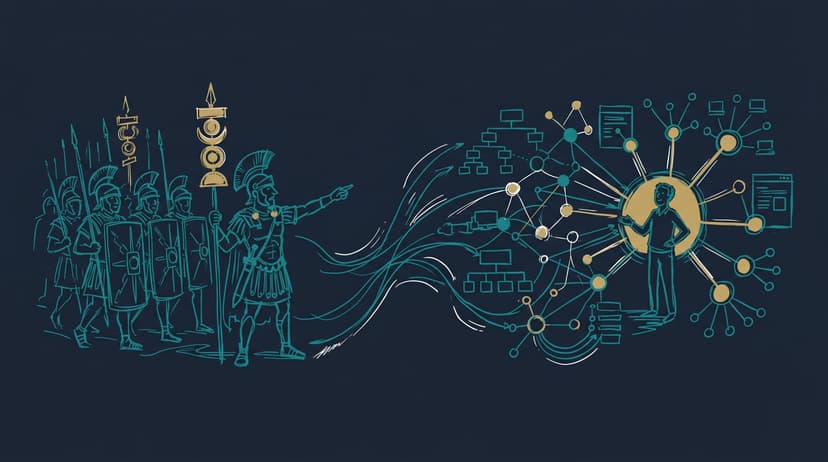
In April 2026, Jack Dorsey published an essay describing how Block is redesigning its entire organisational structure around AI. The core argument: hierarchy exists primarily to route information. People report to managers who synthesise and pass information upward; decisions flow back down. AI can handle much of that routing, which means the traditional org chart is ripe for fundamental change.
This is not the genesis of the idea. Many researchers, consultants and practitioners have been considering AI-native organisational design and the role of intelligence elsewhere for years. Block's essay is the latest high-profile expression of that broader conversation, one that makes the case vivid for large enterprises and also helps us translate the principles for solo and small teams.
Across these sources, a common architecture is emerging with three layers:
- A world model: machine-readable knowledge about how the organisation works, its products, its customers, its processes
- An intelligence layer: AI that routes information, composes solutions, and coordinates across functions
- Humans at the edges: providing judgment, creativity, relationships, and the decisions that matter most
It is a compelling vision wherever you encounter it. But the research and case studies are written for companies with thousands of people and the resources to build bespoke infrastructure. Most of the people reading them, solo operators, micro teams, small organisations, might reasonably think: that's interesting, but it's not for me.
We think the opposite is true.
The translation that's not so obvious
Almost all thinking on AI and organisational design targets large enterprises. McKinsey's "Agentic Organisation" research, Deloitte's work on AI adoption patterns, Ethan Mollick's frameworks at Wharton: important work, but aimed at hundreds or thousands of people.
Very little exists for teams of 1 to 25. And the opportunity there is arguably greater: fewer layers to flatten, faster adoption, and the chance to build AI-native from the start rather than retrofitting.
Here is what this enterprise architecture maps to at small scale:
| Enterprise concept | Solo/small equivalent | Approximate cost |
|---|---|---|
| Capabilities (atomic primitives) | Skills: modular, composable capability packages | Free (your time to forge them) |
| World Model (machine-readable company knowledge) | Context portfolio: structured files your AI can navigate | Free (structured markdown) |
| Intelligence Layer (routes info, composes solutions) | AI harness: Claude Code, skills orchestration, prompt architecture | ~£170/month |
| Interfaces (Square, Cash App, Afterpay) | Client portals, websites, products, deliverables | Varies (often free tier) |
| MCP + tool connections | MCP + tool connections: CRM, research, email, data | ~£30/month |
The tooling cost: roughly £200 per month. But the real investment is the knowledge and time you put into structuring your context and forging your skills. The tools are accessible; the architecture you build with them is where the value lies.
What you discard, what you keep
What you discard: the overhead of thousands of people. The politics. The information routing problem that hierarchy was built to solve (you don't have it; there's one of you). Massive data infrastructure.
What you keep: the architecture. The principle that intelligence lives in the system, not in people's heads. The world model that compounds daily. The emergent roadmap (when the system tries to do something and can't, that gap IS your roadmap).
What you add: skill-forging. Large enterprises have hundreds of engineers to build their intelligence layer. You build yours one workflow at a time.
Skill-forging: how you actually build it
This is the operational method, and it comes from practice rather than theory.
You encounter a workflow you repeat. Research, client reporting, proposal writing, whatever it is. You work through it with AI, step by step. The first attempt is rough. You iterate. You refine the prompts, the context, the structure. Eventually it works well. You codify it into a reusable skill: a document your AI can load and execute next time.
Each skill makes the system permanently smarter. The next time that workflow comes up, it is faster, more consistent, and higher quality. Over time, you build a library of skills that represent your organisation's accumulated capability.
This is fundamentally different from the "give everyone AI tools and hope good practices spread" approach. That model, documented by Every and others, has merit in creating personal ownership and fast adoption. But it tends to mirror existing workflows (which may be inefficient) rather than rethinking them, and knowledge stays in individuals rather than compounding across the operation.
Skill-forging is deliberate. It is "humans at the edges" made concrete: the human encounters a repeatable process, works through it with AI, refines it, crystallises it into a skill. The system's intelligence gets smarter. The human moves to the next edge problem.
A live example
Here is what this looks like in practice. Take client proposals: understanding the brief, researching the prospect, drafting the narrative, tailoring the pricing, formatting the document. The first time you do this with AI, it is rough. You spend as long correcting as you would have spent writing from scratch.
By the fifth iteration, you have refined what the AI needs to know: your services, your tone, your pricing structure, the questions to ask about each prospect. You save that as a skill. Now every proposal starts from a strong draft rather than a blank page, and the quality improves with each use because the skill captures what worked.
That is one skill. Over time you build dozens: research briefs, client reports, grant narratives, meeting preparation. Each one is a permanent capability gain. Together, they form an intelligence layer that compounds daily.
What this looks like for a small organisation
Consider a wildlife foundation with 16 staff and annual income of £1.3 to 2.6 million. Professional, mission-driven, but resource-constrained. One fundraiser covers everything: grant writing, donor research, corporate partnerships, event fundraising, trust applications.
With skill-forging, that one fundraiser could build:
- A donor research skill: AI that scans prospect databases, cross-references giving history, and produces briefing notes before every meeting
- A grant narrative skill: takes the organisation's impact data and theory of change, and drafts funder-ready narratives tailored to each application's requirements
- A funder landscape skill: maps the funding landscape for specific programme areas, identifying alignment between the foundation's work and funder priorities
Each skill is forged through real use: the first grant narrative draft is rough, the tenth is genuinely good, the twentieth is better than most people could write from scratch. And every skill is available to anyone in the organisation, not locked in one person's head.
This is not enterprise transformation. It is practical capability building, one workflow at a time, for an organisation that cannot afford to hire three more fundraisers but can invest the time to build AI capability deliberately.
The honest landscape
We are not the only ones thinking about this. The field is active:
- Mollick at Wharton offers the most complete integrating framework (his Leadership, Lab, Crowd archetypes span top-down and emergent approaches)
- McKinsey's "Agentic Organisation" research maps how large companies are restructuring around AI
- Deloitte documents organic adoption patterns and human-agent team structures
- Every captures the personal agent ownership model and bottom-up culture change
All valuable. But almost nobody is writing for teams of 1 to 25. The solo consultant, the micro team, the small foundation. That is where the transformation is most accessible and arguably most impactful, and it is where we focus.
What to do this month
The gap between those building AI capability deliberately and those waiting to see what happens is widening. You do not need to redesign everything at once. But starting matters.
If you are a solo operator:
- Pick one workflow you repeat weekly. Do it with AI. Note what works and what doesn't.
- Write down what your AI needs to know about your business: clients, services, tone, priorities.
- Save that as a file your AI can reference. You just started your context portfolio.
If you have a small team:
- Have each person identify the task they spend most time on that AI could help with.
- Start a shared knowledge file: who your clients are, what you do, how you work.
- When someone gets a workflow running well with AI, write it up so others can use it. First skill forged.
If you want to go deeper:
Read our full framework on Intelligence and Talent, which covers the two emerging approaches (architecture-first versus emergence), what changes in practice when AI enters the equation, and practical steps for solo, micro, and small organisations.
THE BOTTOM LINE
Large enterprises are spending millions to build intelligence layers for thousands of people. The same architectural principles are accessible to a solo operator or small team with modest tooling costs and a willingness to invest time in building it deliberately. The method is skill-forging: one workflow at a time, refined through real use, compounding daily. The question is not whether to start. It is what to build first.